
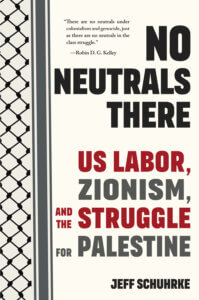
Jeff Schuhrke’s No Neutrals There: US Labor, Zionism, and the Struggle for Palestine (2025) deftly cuts through deceitful arguments in the context of the ongoing Gaza genocide that the US labor movement shouldn’t concern itself with “remote” foreign policy issues, demonstrating the reality that American trade unions “have never been silent or neutral on the question of Palestine.” Alfie Hancox spoke with Schuhrke about the history of US union complicity in empire and Zionist colonialism, the challenges of labor solidarity in settler-colonial contexts, and lessons for labor organisers today.
Running through No Neutrals There is your scrutiny of the union-state nexus, building on your analysis in Blue-Collar Empire, to show the American Federation of Labor and Congress of Industrial Organizations (AFL-CIO)’s active role in the imperial and colonialist state projects of the US and Israel. (I was reminded of when George Padmore, speaking to the UK context, referred to the union leadership as “junior partners in imperialism.”) How has this union-state relationship changed over time?
Workers’ movements in the US have historically faced harsh repression after being smeared as seditious, foreign conspiracies. In response to this, the first president of the AFL, Samuel Gompers, was always desperate to achieve respectability and legitimacy for the Federation and its affiliated unions by demonstrating patriotism and loyalty. When the US entered World War I in 1917, Gompers eagerly threw the AFL’s support behind the war effort. This meant echoing Woodrow Wilson’s claim that the war was a righteous cause to win self-determination for oppressed European peoples, including Jews. At the AFL’s national convention in November 1917, which was personally attended by Wilson, a pro-war resolution was passed that included a plank officially endorsing the Zionist aim of establishing a Jewish homeland in Arab Palestine. This occurred just days after the fateful Balfour Declaration. So, right from the beginning, American labor officialdom’s formal support for Zionism was linked to its support for the US government’s global ambitions and militarism.
Jumping ahead to the late 1940s, unions in the US had grown to unprecedented size and strength partly thanks to pro-labor laws and agencies established under FDR during the New Deal and World War II. As the Cold War began and anticommunist hysteria was used to curb the power of organized labor—as evidenced by the passage of the anti-union Taft-Hartley Act in 1947—top officials from both the AFL and CIO (which merged into the AFL-CIO in 1955) were eager to prove their worth by helping Washington wage the Cold War abroad. This meant partnering with the State Department, CIA, and other parts of the US foreign policy apparatus to sideline class-conscious, left-wing trade union movements around the world. Wanting to convince Third World workers that they could experience economic development without embracing Soviet-style state socialism, AFL-CIO leaders held up the newly established State of Israel and its ostensibly worker-centric economy as a model to be emulated. Over several decades, they donated hundreds of millions—possibly billions—of dollars from union treasuries to assist Israeli “nation-building.” They also used their close connections with the US government to intensely lobby on Israel’s behalf during the state’s precarious early years, long before AIPAC and other groups that comprise what we know today as the “pro-Israel lobby” came into being.
In the decades since the Cold War ended, the US labor movement has become much smaller and less important in the eyes of the American state, while the US working class has been significantly beaten down. And yet, with some exceptions, the AFL-CIO has generally remained loyal to the project of US global hegemony—wanting to put China in its place, etc.—still apparently grasping for the same respectability Gompers yearned for in the hopes it might translate into pro-worker and pro-union policies. But also in the last several decades, especially since the Vietnam War, rank-and-file unionists and a handful of progressive labor leaders have frequently organized against US imperialism and militarism. The recent controversies within the American labor movement over whether to take a position on the Gaza genocide, whether to even acknowledge it as a genocide, are indicative of this ongoing tension.
In the book you excavate the US labor movement’s deep emotional and “ideological commitment” to Israel, particularly in the vision of Labor Zionism as a “socialist”, worker-led nation-building project—a vision dependent on the colonial erasure of Palestinians. Given this, and the history of racial exclusionism within US trade unions which you also explore, what does your book tell us about the ways that core union principles of solidarity and internationalism can be mobilised towards oppressive, rather than emancipatory, ends?
I think it shows what happens when unions prioritize nationalism, racism, imperialism, and colonialism over class consciousness. The early American labor movement championed westward expansion, settlement, and homesteading as ways for white workers in the cities of the eastern US to escape the toil and drudgery of wage labor. But this was all premised on the violent dispossession of Indigenous nations. Organized labor also led the charge in anti-Chinese and anti-Asian sentiment and immigration restrictions. For decades, the AFL essentially looked the other way as many of its affiliated unions excluded Black workers or put them into segregated locals. Of course, there are positive counter examples of unions being more inclusive, such as the Industrial Workers of the World and the CIO’s more progressive affiliates, but we should recognize these as the exceptions to the rule throughout most of US labor history.
In similar ways, Labor Zionism in Palestine—embodied by the Histadrut—was premised on the systematic exclusion of native Palestinian workers. And it should be recognized that Labor Zionism wasn’t simply about protecting and organizing workers, but about doing the actual work of settler colonialism, of building a Jewish-only economy in Arab Palestine. Its explicit goals were the conquest of land and the conquest of labor, aiming to economically marginalize Arab workers and peasants with the goal of pushing them out of Palestine to make way for a Jewish state. To the extent they were included in the Histadrut at all, Palestinian workers were typically rendered second-class status. Here too, there are some historical counter examples of a minority of anti-Zionist Jewish workers uniting with Palestinian workers, but these also are exceptions to the rule, because Zionism dominated.
As Joe Hill said, there is power in a union. But when that power is used to marginalize certain groups of workers, or to further the goals of empire and conquest, then it can be quite the opposite of what I think Hill had in mind. This is why it’s so important for workers everywhere to ensure that their unions and their labor movements are driven by principles of internationalism and class solidarity, and living up to those principles in their day-to-day activities.
One of your book’s most compelling aspects is its weaving back and forth between the histories of empire and resistance in Palestine and in the US, where the labor movement has its own national settler-colonial history. What has been the role of Palestinian and Arab workers in challenging colonialism, both in Palestine and the American “heart of empire”?
In the interwar years, several Palestinian Arab worker organizations were formed to push back against the economic dislocations caused by Labor Zionism and to protest British imperial rule. This most famously took the form of a six-month general strike in 1936, which kicked off a wider Arab revolt that was ruthlessly put down by the British authorities, foreshadowing the similarly ruthless methods used by Israel to crush all Palestinian resistance right up to the present. The Palestinian labor movement faced a major setback after the Nakba in 1948, which saw 750,000 Palestinian Arabs made into refugees and a new settler state established on their lands. Numerous new trade unions were organized in the occupied West Bank and Gaza Strip from the late 1960s onwards, but they faced constant repression from the Israeli occupation forces, which regarded them as “terrorist fronts.” During the First Intifada (1987–93), these unions staged multiple general strikes that disrupted the Israeli economy, so the Israelis imprisoned, tortured, and deported many Palestinian union leaders. In more recent decades, Palestinian trade unions have championed the Boycott, Divestment, and Sanctions (BDS) movement and have repeatedly called on unions around the world, including in the US, not to contribute their finances, political influence, or labor toward supporting Israel’s war machine.
In the US union movement, one of the earliest instances of Palestine solidarity I came across in my research was in 1949, when a group of Arab American members of the International Ladies Garment Workers Union (ILGWU) convinced their union president, David Dubinsky, to donate $5,000 in union funds to aid Nakba refugees. This was nothing compared to the millions of dollars the ILGWU and other unions were busily giving to the Histadrut and newfound State of Israel, but it’s still significant that it happened at all. Later, in 1973, around 2,000 Arab American autoworkers in Detroit held a one-day wildcat strike at the Dodge Main assembly plant to protest their own union—the United Auto Workers (UAW)—for purchasing Israeli state bonds. They compared their anger to how Black UAW members would feel if the union were investing their dues money in apartheid South Africa. In more recent decades, US union members of various races, religions, and backgrounds have supported the Palestinian freedom movement by getting their unions to pass pro-Palestine resolutions and endorse or practice BDS, but have typically faced intense backlash from high-ranking labor officials and anti-Palestinian groups accusing them of “antisemitism.” Given the enormous role the US plays in enabling Israel to continuously suppress the Palestinian freedom movement and commit all manner of atrocities, I think the American labor movement has a special responsibility to stand in solidarity with Palestinians, particularly through BDS.
In addition to ideological affinities, you also reveal the US labor movement’s material investments in Zionist colonialism through Israeli bonds, its defence of jobs in the arms-exporting industry, and more broadly its frequent identification with the interests of global US hegemony. What are your thoughts on the extent of American workers’ incorporation into the project of empire?
American workers are deeply incorporated into the project of empire—and typically not by choice, but by larger economic and political forces controlled by the ruling class. And it’s much bigger than US support for Israel; it’s the countless interventions, coups, proxy wars, and direct military campaigns associated with the Monroe Doctrine, Cold War, “War on Terror,” and increasingly now the so-called “Great Power Competition.” It’s not only workers in the weapons manufacturing industry, but also tech workers and academic researchers whose labor often feeds the military-industrial complex. But more broadly, it’s our tax money being used to fund militarism and imperialism, and it’s our elected officials of both parties, who purport to democratically represent us, who are making these decisions.
But the point of both my books is to demonstrate how US labor officialdom, particularly the AFL-CIO and its major affiliates, has willfully and directly participated in American imperialism by historically partnering with the foreign policy establishment and operating abroad as an appendage of Washington, rather than as an independent force for social and economic justice and genuine working-class solidarity. This includes union officials’ enthusiastic, material backing of Zionism and the State of Israel at the direct expense of Palestinian self-determination and human rights. This, I think, is different from the broader way that US workers are implicated in empire (our labor, our tax money, etc.), because this is a very conscious, deliberate, even enthusiastic choice made by many labor leaders.
As well as elucidating the principles of true labor solidarity, No Neutrals There shows the importance of paying attention to the institutional workings of unions, for example the vital role of internal union democracy in combatting racist and imperialist policies. What did you learn from trade unionists while researching and writing the book?
That it takes serious commitment to the labor movement, as well as determination and perseverance, to try changing one’s own union on these issues. There have been various instances, described in the book, where trade unionists fairly and democratically decided to take a stand for Palestine—usually only a rhetorical stand—only to then be undemocratically overruled by higher-up union officials. This can be so discouraging, and for some anti-war/anti-imperialist activists, it can be easy to simply write-off the US labor movement as hopeless. Unionists who are part of various pro-Palestine caucuses, the Labor for Palestine network, and the Labor Network for Ceasefire are doing such valuable work to try uniting the anti-war movement with the labor movement, to prove that unions can indeed be a force for social justice, and it is thankless work. But I think it’s inseparable from questions of union democracy and how much of a say rank-and-file members really have over their organizations.

While the history of US labor’s complicity in Zionist colonialism is a depressing one, you have also traced the irrepressible threads of resistance. What are the openings for an anti-imperialist labor politics in the US today, where many workers are strategically located in the weapons manufacturing industry?
Usually when there’s a conversation about the role unions can play in hindering militarism and empire, many people’s minds understandably jump straight to the idea of strikes to shut down the production and shipment of weapons. Then union leaders and veteran organizers will explain how, given the realities of labor law and low union density in the US, talk of such militant action is highly unrealistic. But part of the reason why antiwar strikes are “unrealistic” is that the unions that represent workers in war-related industries are generally not doing—and maybe not interested in doing—the kinds of organizing, political education, and political lobbying necessary to begin making it a more realistic idea. This might include advocating for an industrial policy to convert weapons-manufacturing plants into plants that manufacture peacetime, civilian products so workers’ job security wouldn’t have to be tied to Pentagon appropriations and the continuation of armed conflicts.
In any case, what often gets forgotten, in my opinion, is that there are relatively easier, lower-stakes activities US unions can do in the short term. One is disclosing and divesting their own financial holdings in companies that profit from war and human rights abuses, whether in Palestine or elsewhere, as well ending their investments in State of Israel bonds if they still have any. Another is refusing to endorse, donate to, or do get-out-the-vote work for political candidates unless they meet specific criteria on important matters of war and foreign policy. American unions can also send delegations to occupied Palestine or other places impacted by US empire, or bring delegations of unionists from such places to tour the United States, to build real worker-to-worker understanding.
I think maybe where we see the most promise right now is among higher ed unions, especially graduate worker unions, which have grown significantly in recent years. Such unions are naturally tied to campus anti-war organizing, and in the STEM fields especially, their members are often doing research that serves the military-industrial complex, so they can potentially have a real impact. The spring 2024 strike by University of California grad workers and postdocs with UAW Local 4811—which was in solidarity with the pro-Palestine, anti-genocide campus protesters—was an extraordinary example of what can be possible when unions are both well organized and politically conscious and principled.
Importantly, through the “No Tech for Apartheid” campaign, non-union workers at tech giants like Microsoft, Google, and Amazon have been doing some incredible organizing to pressure those companies to cut all ties with the Israeli government and military, which use their AI and cloud computing services for surveillance and targeting. With no union contract to protect them, these workers have demonstrated amazing courage by holding sit-ins at corporate offices, disrupting corporate conferences, and just constantly calling out their bosses for being complicit in war crimes and crimes against humanity. The fact that workers are so passionate over this should demonstrate to established unions that Palestine is an issue around which they can organize and grow membership.


